
In her recent visit to the White House on the 19th of March, Japanese Prime Minister Sanae Takaichi met with President Donald Trump. Among talks on investment security and agricultural exports, the recent US strikes on Iran were compared by the US President to the Japanese attack on Pearl Harbour in 1941.
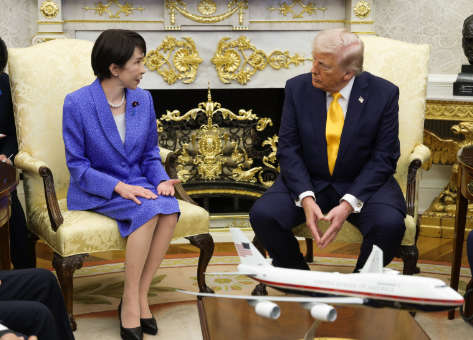
On Thursday 19th March, Japanese Prime Minister Sanae Takaichi met with President Donald Trump in the Oval Office for the Japan-U.S. Summit Meeting. Being her second meeting with the current President, having met him in October last year for the first time, opening remarks between the two world leaders were positive and complimentary.
The Ministry of Foreign Affairs of Japan noted that President Trump praised Takaichi as a “very popular, powerful woman” who was doing a fantastic job in leading the large, reputable nation of Japan. Takaichi, in return, expressed her admiration of President Trump in his commitment to the Japan-U.S. alliance, hoping to continue cooperation between their respective nations and maintain a strong relationship. Her visit comes after recent comments by the U.S. President that claim Japan was among those who failed to help protect the Strait of Hormuz in light of the recent developments in the Middle East, namely U.S. strikes on Iran.
At the end of February this year, the United States conducted ‘Operation Epic Fury’, launching a surprise attack on Iran with help from the state of Israel. The White House Press Secretary Karoline Leavitt has outlined the aims of this military operation - to “destroy the terrorist regime’s ballistic missiles, raze their Iranian missile industry to the ground, ensure their terrorist proxies can no longer destabilise the region, and ensure that Iran never obtains a nuclear weapon”. These aims were echoed by Secretary for War, Pete Hegseth, who listed three key objectives; “one, destroy their missile stockpiles, their missile launchers and their defense industrial base (...) two, destroy their navy. And three, permanently deny Iran nuclear weapons forever”.
The strikes on Iran resulted in the death of the Supreme Leader Ayatollah Ali Khamanei and a swathe of military and government officials. Since the initial strikes, Iran has retaliated with ballistic missile and drone strikes reported in Israel as well as Jordan, Cyprus, Lebanon, Bahrain, Oman, Qatar, the United Arab Emirates, Syria, Kuwait, Turkey, Azerbaijan and Saudi Arabia.
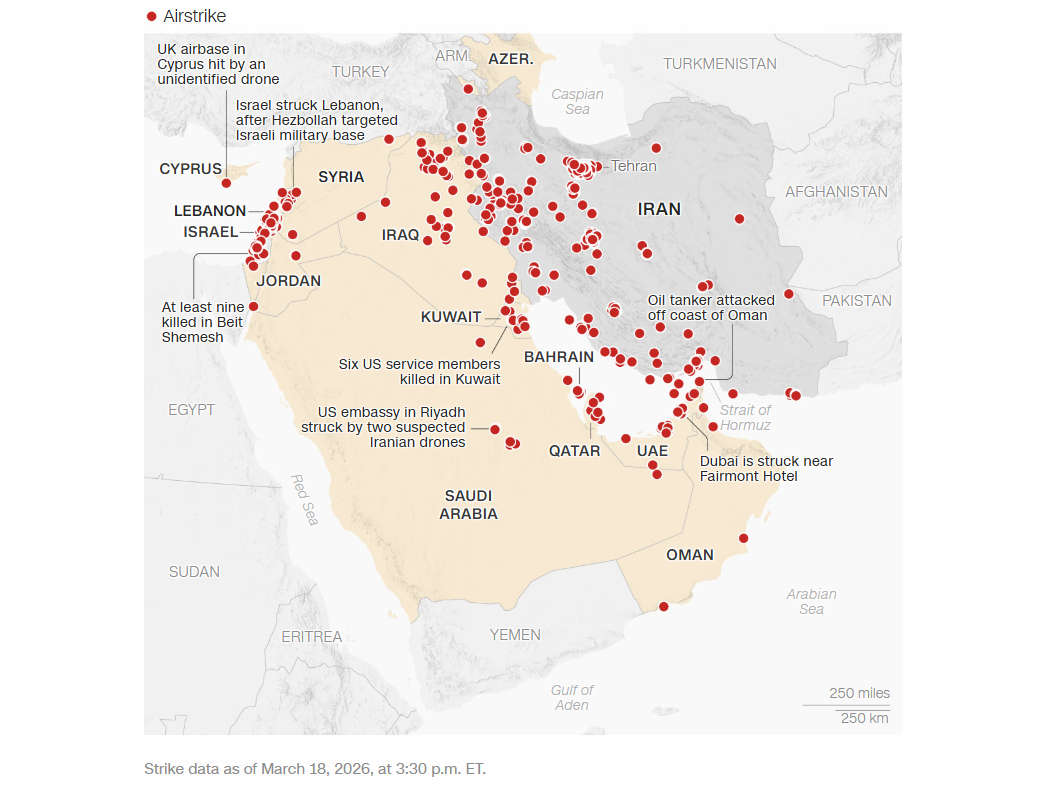
Map of air strikes in the Middle Eastern region as of 18th March 2026, CNN.
The meeting between the Japanese and U.S. leaders was, overall, positive. Discussions were held concerning regional security, with reference made to North Korea and Taiwan, science and technological developments, industry and energy security, and trade, with talks had concerning U.S. agricultural exports as well as industrialisation and investment security. Among these other significant concerns and points of discussion, talks shifted to the international situation in the Middle East, as described above. It’s safe to say the atmosphere in the Oval Office grew tense, as President Trump made sudden reference to the Japanese attack on Pearl Harbour during the Second World War.
In response to a journalist asking why the United States had not warned its allies, including those across Europe and Asia, including Japan, about its intent to attack the state of Iran, the President responded:
“We didn’t tell anybody about it because we wanted surprise - who knows better about surprise than Japan? Okay, why didn’t you tell me about Pearl Harbour?”
The comment was clearly unexpected, and among a few awkward laughs from journalists and others present, Takaichi visibly reacted, her eyes widening and folding her hands as she leaned back in her seat. Beyond appearing uneasy, however, the Japanese premier kept her composure and didn't respond. A senior reporter, Mineko Tokito, who was in the room at the time, stated that there was a “clear” discomfort in the Prime Minister.
Some have praised Takaichi for keeping her composure, though others have criticised her for not addressing the issue. On the whole, however, criticism over the comment has been targeted towards the U.S. President, with the Asahi newspaper stating that such a remark used “to justify a sneak attack and boast about its outcome is a piece of nonsense that ignores lessons from history” and as such “should not be overlooked”.
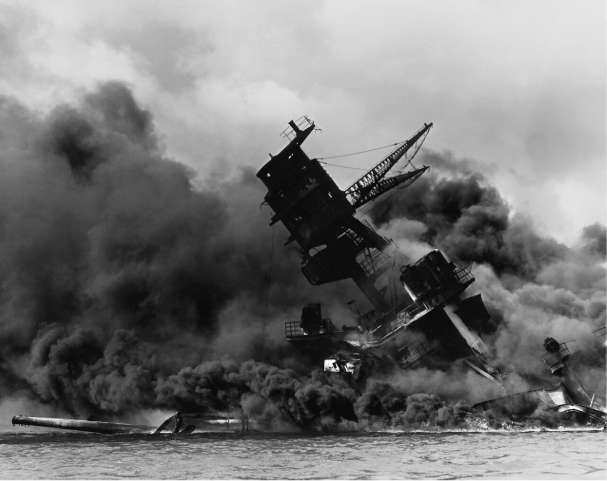
The USS Arizona, 7th December 1941, after the Japanese attack on Pearl Harbour. The ship currently rests at the bottom of the harbour.
The attack on Pearl Harbour has remained a sensitive topic for many Japanese as well as American citizens. While the two nations have been allied since 1952, during the Second World War this was not the case - on the 7th December 1941, the Japanese launched a surprise attack on the Pearl Harbour naval base in Hawaii. The attack on U.S. soil led to the deaths of 2,335 military personnel as well as 68 civilians and was followed by a declaration of war.
Aggressions between the two states would come to a head in August of 1945, when the United States dropped atomic bombs on the Japanese cities of Hiroshima and Nagasaki respectively. Being the only use of nuclear weapons in wartime, these strikes led to the surrender of the Japanese the same month. The estimated death toll in Hiroshima sits between 140,000 and 350,000, with an additional 74,000 estimated to have been killed in the attack on Nagasaki.
The United States and Japan, now allies, have since worked to reconcile and build a strong relationship based on mutual respect and peace, with previous national leaders Barack Obama and Shinzo Abe paying mutual respects to their ally, with visits to the Arizona Pearl Harbour memorial and Hiroshima Peace Park respectively in 2016. While these past tragedies of war are not forgotten, they are commemorated and serve as reminders for the necessity of international peace and security.
The reaction of Takaichi to the unexpected and nonchalant reference to such a sensitive topic in the allies shared history indicates no cause for concern, but the commentary from Trump does raise questions as to the appropriateness of certain remarks and their impact on both state alliances and the wider world perception of the United States at this juncture.
 New party founded by Corbyn adopts Your Party as name
 Reeves delivers 2025 Autumn Budget — sweeping tax rises and cost-of-living relief
 Home secretary signals overhaul of policing structure in England and Wales
 Russian spy ship pointed lasers at RAF pilots tracking it
 Ousted Bangladesh leader Sheikh Hasina sentenced to death
 Trump Backs Release of Epstein Files as Feud with Marjorie Taylor Greene Explodes