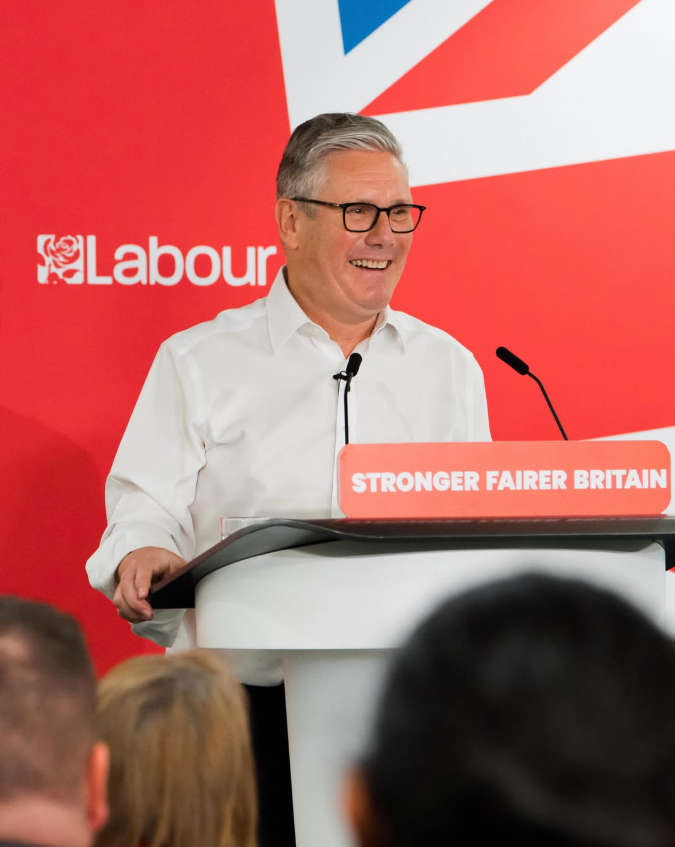
The results from the UK local elections this May are in! The gaining of seats by third parties has left the UK's two-party system hanging in the balance. Meanwhile, the Labour Party has begun to question Starmer's leadership, some calling for his resignation.
The UK held its local elections on the 7th May, and the results and fallout since has been transformatory for the political climate of the country and interesting to analyse.
Image of a 'Polling Station' sign
What are Local Elections?
Local elections are held every four years, though its key to note that not all local authorities hold their elections at the same time. The elections on Thursday 7th May, while not including every local authority, council or region still encompassed a large range of England, Scotland and Wales.
Local elections differ from General Elections, as instead of choosing a Member of Parliament (MP) to represent your area, you are voting for councillors and the outcome of a local election will both determine a gain or loss in councillors for a political party, as well as control over a council, based on that number of councillors increasing or decreasing.
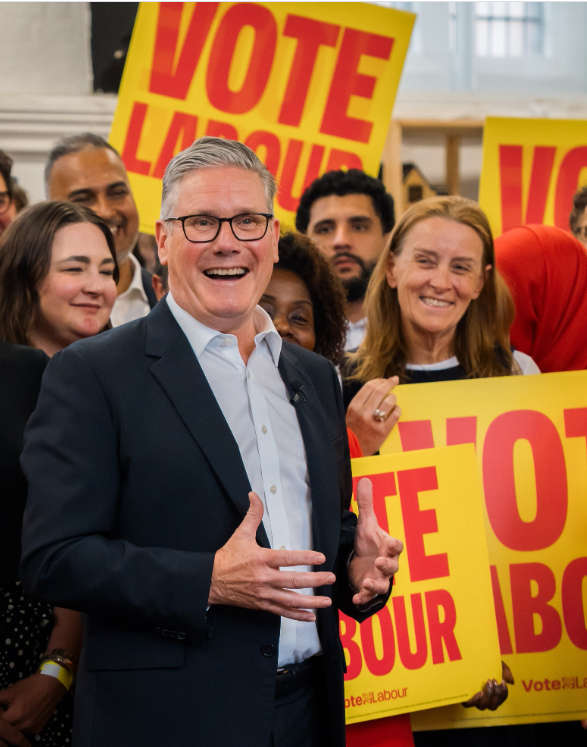
Sir Keir Starmer prior to the election, Instagram @uklabour
Predictions
Going into these elections, political commentators and analysts had two key assumptions;
First, this election would be significant for third parties, and may therefore affect the long-standing two-party political system in the country. The United Kingdom has always operated on a two-party system, being that, while other political parties have existed across England, Scotland and Wales, there have been two parties holding a majority of the vote and therefore dominating politics, with one of the two typically ending up in power - in the UK, this has historically been the Conservatives and Labour. The Labour Party have been in power since their landslide General Election victory in 2024, and prior to that, the Conservatives held power for fourteen years. The last time a third party held any form of national office in the UK was during the coalition between the Conservatives and Liberal Democrats in 2010 which secured Conservative Prime Minister David Cameron his election victory.
However, in recent years, there has been a surge in third parties, and in tandem, a widening of the UK’s political system, with these minor parties either leaning further to the right, or the left of the political spectrum. The Liberal Democrats have always existed as a centrist party, but has recently been challenged in their position as a viable third option for government by two key contenders - The Green Party on the left and Reform UK on the right. These two parties were predicted to make significant gains, the Greens due to their recent polling popularity, and Reform in light of recent discontent with political leadership. Independent councillors as well as newest political party Your Party, formed in September of last year, were also projected to do quite well.
Second, the fate of the Labour Party in power, and particularly the state of Keir Starmer’s leadership, would be determined by this election. Recent polling data prior to the election has shown discontent with the lack of change brought about by Labour since their election victory two years ago, and many have put into question the ability of the Prime Minister to serve the country. Being that this would serve as the first set of significant elections since Starmer took power, it would be critical for his party to do well in order to maintain their mandate to lead the country.
The Results
Once fully counted, the votes resulted in a significant shift in the country’s political landscape, as demonstrated in the figure below:
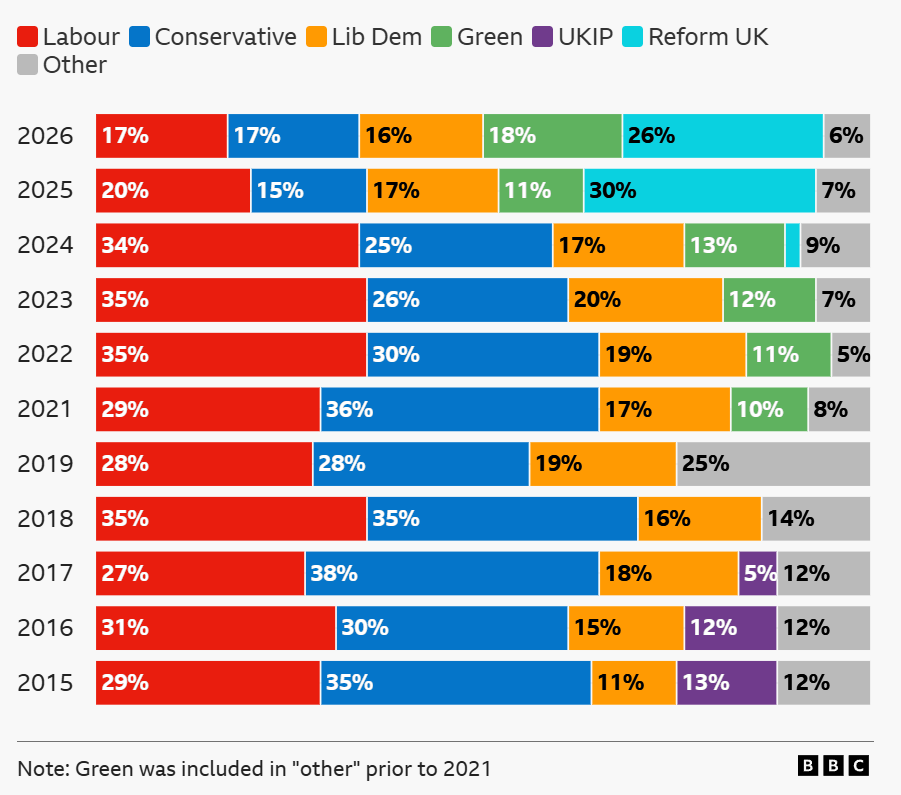
Figure showing change in vote share from 2015 to 2026, BBC
The most gains were made by Reform UK, who, in addition to gaining control of 14 councils, gained 1,400 councillors. The most losses? The Labour Party lost more councillors than were even gained by Reform, losing a total of 1,498. The main death blow to Labour came in Wales, where they went from 1 in 2 councillors being their own, to 1 in 10, the Welsh chamber now dominated by Plaid Cymru and Reform UK.
The sheer success of Reform UK during this election is significant to the political culture of the UK for several reasons - party leader, Nigel Farage, has been an outspoken political figure for many years now, and particularly since the Brexit referendum in 2016 which eventually led to the UK leaving the European Union. Farage has led his third party under a variety of names and identities, from UKIP, to the Brexit Party and now Reform. However, much of his party's ideology and manifesto have remained, with a key focus on polarising issues such as immigration and diversity, equality and inclusion. Farage's success here either indicates a sharp turn in the priorities of the nation, or indicates what is commonly known as a 'protest vote', meaning the electorate saw Reform UK as the most viable alternative to a current leadership that has fallen out of favour - that being the Labour party.
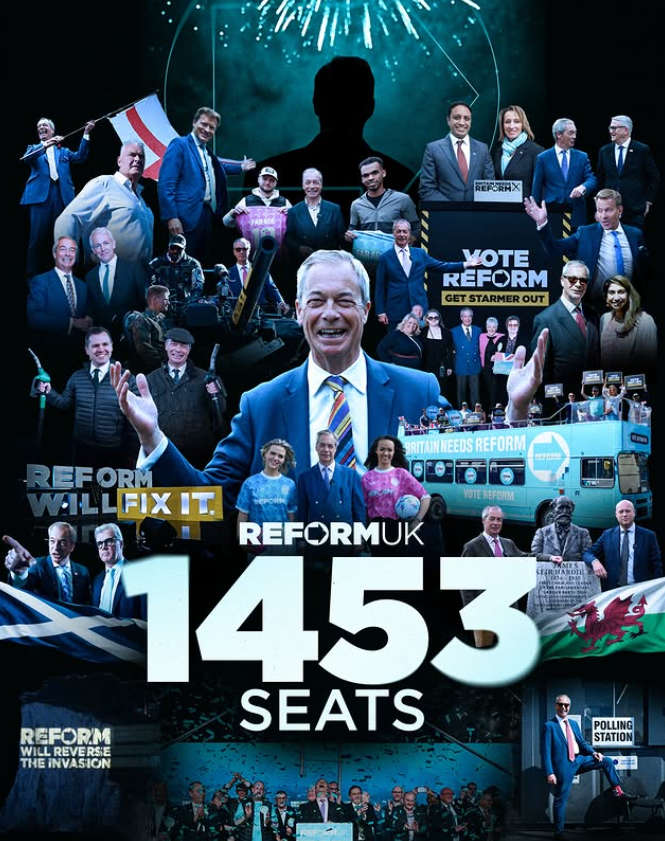
Image celebrating councillor seat gains by the Reform Party in the local elections, Instagram @thereformpartyuk
Meanwhile, the Conservatives were faced with losses, while minor gains were made by the Liberal Democrats, and historic gains were made by the Green Party, who now hold 5 councils with 587 councillors, proving right predictions of their rising popularity as a viable left-wing party in the United Kingdom.
Many have commented on this being the death of the two-party system in the UK, with the most political diversity across the nation ever seen, and a significant drop in the support for the primary two parties, Labour and the Conservatives, with favour and ultimately votes instead going to third parties like Reform and the Greens, rather to one or the other.
The Fate of Starmer’s Labour
The current focus in the election fallout, however, has been the fate of Prime Minister Keir Starmer and his Labour Party, as he faces a potential challenge to his leadership. The success of Reform UK has been almost mirrored by the losses taken by Labour, perhaps indicating a protest vote, as described above. This idea is only further supported by the response of Starmer's cabinet and ministers.
As of Thursday, Wes Streeting became the latest to resign from the government, following four ministers who handed their resignations to the Prime Minister over the past few days. Streeting is replaced as Health Secretary by James Murray.
This swathe of resignations comes as a direct response to the election results, happening almost straight away. The loss of over 1,400 councillors and 38 councils has shaken faith in Starmer's leadership, with some Labour ministers and former councillors suggesting a new leader is needed to steer the party in the right direction. Almost 100 Labour MPs have now called for the Prime Minister to either resign, or set out a roadmap for his resignation, but in a speech made after the election, Keir Starmer declared he was not going to walk away and has asserted he has no intention of resigning - despite the current discontent in the party, some MPs have voiced their support for the Prime Minister, many quoting that the constantly changing leadership of the country has done and will do more harm than good.
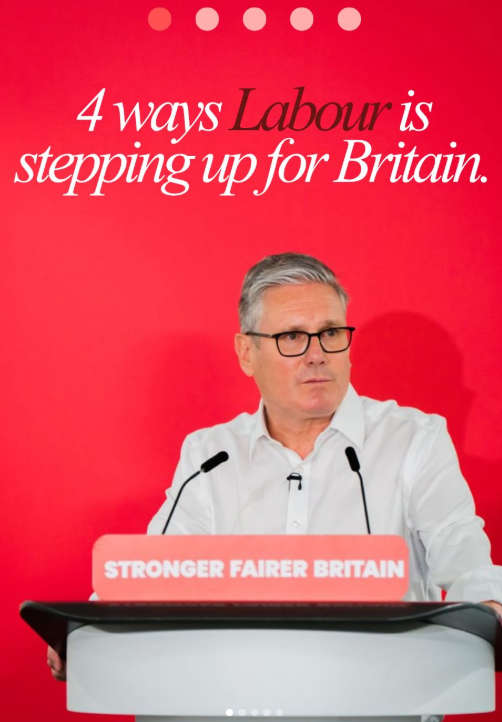
Keir Starmer pictured during his speech after the election results confirmed, Instagram @uklabour
That being said, there are still doubts.
Currently, there is no clear consensus on a replacement, and while almost 100 MPs have called for some kind of resignation from the Prime Minister, 81 of them would need to agree on his successor, as the rules of the Labour Party lay out - this has so far not occured. However, the two prime candidates of the moment appear to be Angela Rayner, former Deputy Prime Minister, and increasingly, Andy Burnham, the current mayor of Greater Manchester, and former MP.
The security of Keir Starmer's position as Prime Minister continues to be put into question by the media and British public, but it is clear regardless of the outcome, that these elections have had substantial impact on the country's politics. Alongside the borderline abandonment of support for a party who won in a landslide General Election only two years ago, the continuing decline of the Conservative Party, changing political dominance in Wales, and the increasing influence of third parties such as Reform and the Greens sidelining and threatening the two-party system, are all consequences of these election results that leave much to be considered.
 What is going on with Reform UK right now?
 The re-defining of Syria on the world stage
 Burnham's shapening speech "I will give this my all."
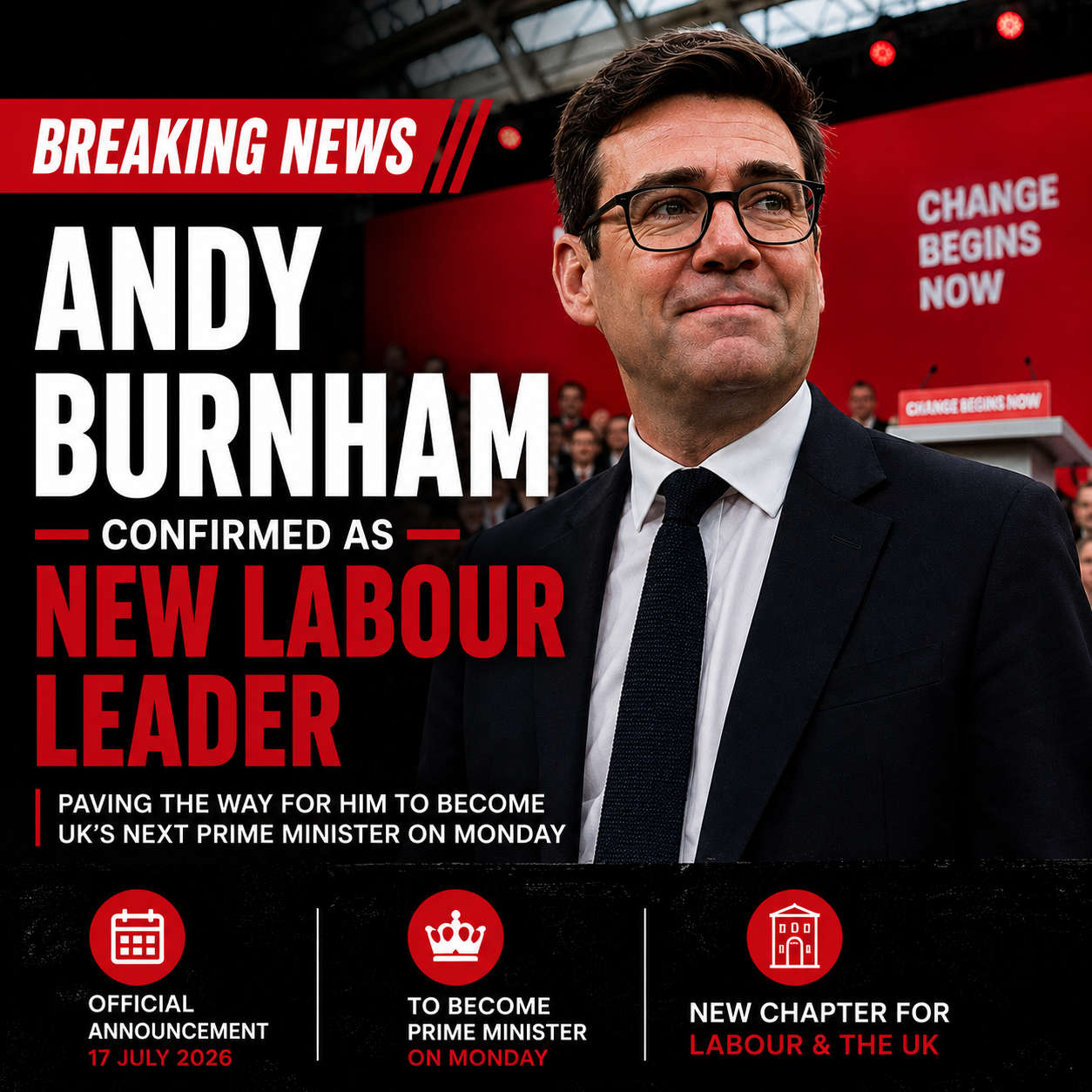 Andy Burnham Confirmed as New Labour Leader Ahead of Move into No. 10
 Man, 26, arrested on suspicion of murder after Ann Widdecombe found dead at home
 Ann Widdecombe Dies Aged 78